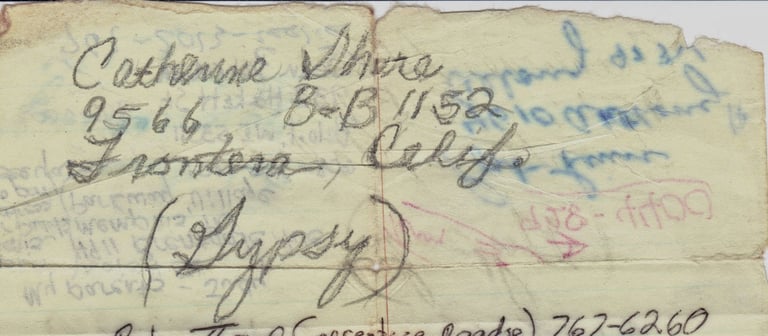
Gypsy
Pepper Scott
Terry was always the kind of person who believed in showing up. If someone needed a hand, he offered two. If a community needed a lift, he found a way to wire the lights, tune the sound system, and brighten the whole room. So of course, in the 1970s, he started putting on concerts in prisons and boot camps, those forgotten corners where hope often sits in the back row. He liked to joke that he was a regular Johnny Cash, minus the black suit and worldwide fame, but with plenty of heart to go around.
He met all kinds of people in those years. Some unusual. Some unforgettable. And then there was Gypsy.
One afternoon at the California Institute for Women, Terry was doing a simple sound check, making sure the speakers behaved. A woman wandered up, thanked him for coming:“No one ever comes here except religious groups,” she said, and introduced herself as Gypsy. She carried a violin and asked if she could play along. So she did, though Terry swore she wasn’t exactly easy on the strings. Still, he let her join in while he tested levels, because that was Terry: generous to a fault, convinced that every small kindness could tilt the world one inch toward good.
When they wrapped up, she handed him her information. “Be sure to write,” she said. “If I get out, maybe I can play with you.” And Terry - absolutely certain he was saving the world one guitar chord at a time - gave her his address. A sweet gesture. A trusting one. Maybe a slightly reckless one in hindsight.
Moments later, a guard walked over and asked if Terry knew who he’d been talking to. “She said her name was Gypsy,” he replied. The guard nodded. “Yeah. Gypsy the Manson girl.”
Terry froze. Tried to look cool. Failed spectacularly. Then came the only reasonable reaction: “WHAT? She has my address!”
He later joked that he pictured himself sprinting back to his little place in Topanga Canyon, tossing his roommates a quick warning as he peeled out of the driveway: “If a bunch of Manson-looking people show up, tell them I died. BYE!” But of course, he stayed put. No mysterious visitors ever arrived. No letters. Just a great story and one very blameworthy Les Paul guitar.
And after all that, Terry would shrug and say, “That’s why I played prisons. Captive audiences.”
A line only he could deliver, soft humor wrapped around a life lived with purpose.