Apache Kid
Pepper Scott
Terry’s father was, in many ways, a walking contradiction. The kind of man who could charm the chrome off a bumper with one smile, then somehow forget to charge for fixing the whole car. Handsome, talented, and blessed with the mechanical instincts of a magician, he could take apart an engine and put it back together as if he were merely solving a puzzle meant only for him.
Business, however, was not his sport.
He trusted too easily, especially the sort of friends who arrive empty-handed and leave with your tools, your money, and occasionally your optimism.
Terry admired him anyway.
That is the curious loyalty of children. A child can build a cathedral out of scraps if love is involved.
His father had served in the Navy in World War II, which, in Terry’s eyes, made him something close to mythological. A real-life hero. The trouble was, heroes do not always return home intact. Sometimes they come back carrying invisible luggage, heavy as wet wool, and far less practical.
His father came home broken in places no doctor could set, and with a bottle that seemed to know his name better than anyone else did.
Still, little Terry kept trying.
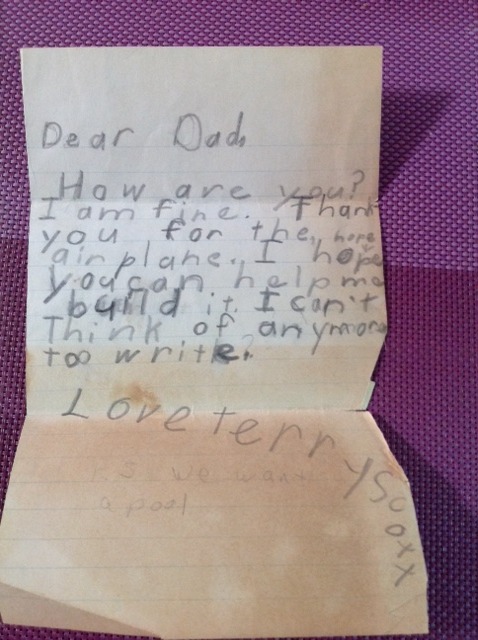
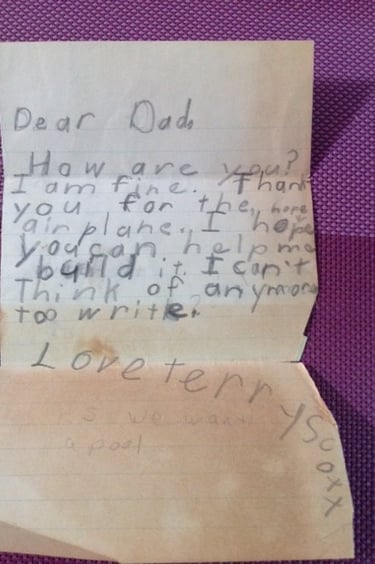
He wrote notes, tiny paper lifeboats filled with affection.
I love you, Dad.
I miss you, Dad.
Small words. Big hope.
Children are wildly optimistic creatures. Give them one crumb of possibility, and they will bake an entire loaf of belief.
But more often than not, Terry received hardness in return. Quick tempers. Quick hands.
Then came the day that changed everything.
Terry was outside playing cowboys and Indians, or more accurately, the highly imaginative and historically questionable game of “kill the Indian.” Back then, this was considered normal childhood entertainment, right alongside marbles and questionable lunch meat.
Blame television.
Blame old westerns.
Blame an era that had all the subtlety of a marching band.
His father caught him.
Terry braced himself. He was certain trouble was approaching at full speed.
But instead of anger, his father did something almost unimaginable.
He called Terry over and sat him down.
“Terry,” he said, “we are Indians.”
Just like that.
No drumroll. No orchestral swell. Just a sentence landing with all the force of a summer thunderstorm.
Terry once told me it felt like being struck by lightning, except somehow in a good way.
“We are Chiricahuas.”
That one conversation, perhaps the only true conversation they ever had, planted something permanent in Terry. A seed, really. Small, but stubborn.
And from that seed grew a lifelong devotion.
Not for recognition. Not for applause.
Just pride.
Quiet, steady pride.
He never chased identity like a trophy, but he wore it like a well-loved jacket.
Comfortable. Honest. His.
And somewhere along the way, that little boy became a man who helped bring tribes together through Native Airwaves, carrying forward a truth his father handed him in one unforgettable moment.
Funny how life works.
Sometimes an entire future can begin with a single sentence.